Is your warehouse starting to feel a little smaller than it used to?
Perhaps stock is piling up, seasonal demand is increasing, or a new contract has brought in more materials than your existing space can comfortably handle.
It’s a good problem to have when business is growing, but running out of warehouse space can quickly become a logistical headache.
And while moving to larger premises might seem like the obvious answer, it isn’t always the most practical or cost-effective solution.
The good news is that there are several ways to create additional business storage capacity without committing to a warehouse relocation.
From making better use of your existing building to hiring a shipping container or outsourcing part of your stockholding, here are five options worth considering.
1. Make Better Use of Your Existing Warehouse Space
Before looking for somewhere new to store your goods, it’s worth reviewing the space you already have.
Warehouse layouts often evolve over time. What worked when the business started may not be the most efficient arrangement today.
Consider:
- Reviewing racking layouts and vertical storage opportunities.
- Identifying slow-moving or obsolete stock that is occupying valuable space.
- Separating frequently accessed stock from items needed less often.
- Reviewing goods-in and dispatch areas to reduce unnecessary congestion.
- Improving stock visibility and inventory management.
Even relatively small changes can release useful capacity.
However, any changes to racking, storage heights or operational layouts need to account for safe loading, handling equipment, access and fire safety requirements.
Best suited to: Businesses with inefficient layouts or spare capacity that isn’t currently being used effectively.
2. Use Shipping Containers for Additional On-Site Storage
One of the most flexible ways to tackle warehouse overflow is to create additional storage space outside your existing building.
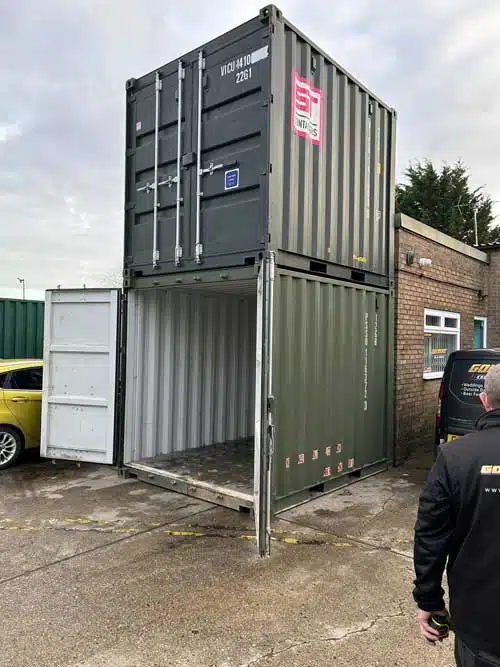
Shipping containers can provide a practical solution for businesses with suitable outdoor space.
Rather than committing to a building extension or a larger warehouse, a storage container can offer additional capacity where it is needed.
Why consider shipping containers for business storage?
Flexible storage capacity
Containers are available in different sizes, including commonly used 20ft and 40ft options. They can accommodate a range of suitable stock, equipment, materials and operational supplies.
Hire or purchase options
Businesses experiencing a temporary increase in demand may prefer to hire, while those requiring ongoing capacity might consider purchasing.
Storage close to your operations
Keeping stock on site can be particularly helpful when materials or equipment need to remain accessible to your team.
Professional delivery and positioning
Container delivery requires suitable vehicle access, ground conditions and sufficient space for unloading. Specialist HIAB vehicles can often be used to lift and position containers where a conventional delivery would be impractical.
Through our container division, ST Containers, we support businesses with container hire and sales, while Sussex Transport provides specialist container transport and positioning services.
What should you check before installing a storage container?
Before arranging a container delivery, consider the following:
- Is there suitable space and ground support for the container?
- Can a delivery vehicle access the intended location safely?
- Are there overhead cables, buildings or other obstructions?
- Will staff need regular access to the contents?
- Are the goods suitable for container storage?
- Are any planning, landlord, insurance or fire safety approvals required?
Condensation, ventilation and moisture control are also important considerations, particularly for sensitive stock.
Best suited to: Businesses needing convenient, flexible storage for suitable goods, materials or equipment on their own premises.
3. Use Temporary or Outsourced Warehouse Storage
Not every business has space for a container, and not every product is suitable for outdoor storage.
In those situations, outsourced warehousing can provide a practical alternative.
Instead of trying to accommodate every pallet or item within your own building, you can arrange for selected goods to be held at a separate storage facility.
This can be particularly useful for:
- Seasonal stock increases.
- Bulk pallet storage.
- Slow-moving inventory.
- Incoming stock awaiting distribution.
- Equipment or materials needed for future projects.
- Short-term overflow during refurbishment or relocation.
Outsourced storage can also reduce pressure on your own warehouse team, particularly when additional stock would otherwise interfere with day-to-day picking, packing or dispatch operations.
At Sussex Transport, our storage and warehousing services offer businesses access to a range of internal and external storage options, supported by our transport and logistics operation.
That means we can discuss not only where goods are stored, but also how they arrive, move and reach their next destination.
Best suited to: Businesses needing additional capacity without taking on more premises or installing storage on site.
4. Review Stock Deliveries and Distribution Patterns
Sometimes a shortage of warehouse space isn’t simply about how much stock you hold.
It can also be about when that stock arrives and how quickly it leaves.
For example, a business might receive large deliveries that occupy valuable warehouse space for several weeks before being distributed.
Where suppliers, customers and stock management arrangements allow, changing delivery patterns may help reduce peak storage requirements.
Options could include:
- Smaller, more frequent inbound deliveries.
- Better coordination between suppliers and dispatch teams.
- Scheduled deliveries for larger or project-based items.
- Reviewing minimum stock levels and reorder points.
- Moving suitable stock to external storage before peak demand.
Of course, smaller deliveries aren’t automatically cheaper or more efficient. Transport costs, supplier arrangements and handling requirements all need to be considered.
But combining smarter stock planning with reliable haulage can sometimes reduce the need for additional permanent storage.
Best suited to: Businesses whose storage pressures are caused by irregular deliveries, seasonal peaks or uneven stock movement.
5. Consider a Combination of Storage Solutions
For many growing businesses, the best answer isn’t necessarily a single storage solution.
It could be a combination.
For example, a company might:
- Keep fast-moving stock inside its existing warehouse.
- Use a shipping container for suitable equipment or packaging materials.
- Outsource bulk pallet storage to a separate facility.
- Arrange scheduled transport to move stock between locations.
This approach allows different types of goods to be stored in locations that make operational and financial sense.
It also creates flexibility. As demand changes, businesses can adjust their storage arrangements rather than making a major property decision every time capacity becomes tight.
At Sussex Transport, our combination of warehousing, road haulage, HIAB transport and container services puts us in a useful position to help businesses consider several different options.
Which Warehouse Overflow Solution Is Right for Your Business?
There isn’t a universal answer. The best solution will depend on the type of goods you store, how frequently you need them, the space available and how long additional capacity is required.
| Storage Solution | Particularly Useful When |
|---|---|
| Optimising Your Warehouse | Existing storage space could be used more efficiently. |
| Shipping Container Hire or Purchase | You have suitable outdoor space and need additional on-site storage capacity. |
| Outsourced Warehousing | You need off-site storage or specialist stock handling. |
| Adjusting Deliveries | Stock arrival patterns are creating temporary congestion. |
| Combining Solutions | Different stock types have different storage requirements. |
Before making a decision, consider both the cost of additional storage and the wider operational impact.
Saving money on storage isn’t much help if accessing your goods becomes expensive, inefficient or disruptive.
Need More Storage Space? Let’s Talk Logistics.
If your business is feeling the pressure of a warehouse space shortage, relocating isn’t necessarily your only option.
Whether you need additional pallet storage, help with an overflow warehousing requirement or a shipping container delivered to your premises, there may be a more flexible solution.
Sussex Transport and our container division, ST Containers, can help you explore the practical options.
Get in touch with our team to discuss your storage requirements and find a solution that works for your business.
Call: 0800 915 23 23
Email: [email protected]
Website: www.sussextransport.com